What Does 4×4 Mean on a Jeep?
Many Jeep owners want to confidently tackle tough terrains but often feel unsure about how their vehicle handles off-road challenges. You’re not alone—navigating tricky surfaces can be a bit intimidating.
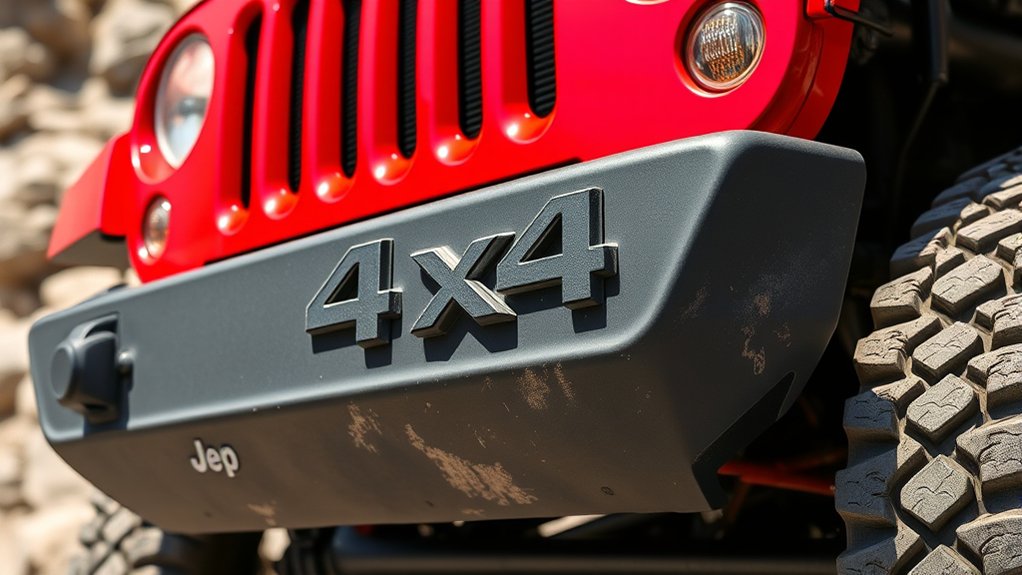
When you see 4×4 on a Jeep, it means all four wheels can receive power simultaneously, which boosts traction and control on tough terrains like mud, snow, or steep hills.
This system is designed to improve stability and help you tackle off-road adventures or slippery surfaces. Understanding how and when to use different 4×4 modes can make a big difference.
Keep exploring to learn more about making the most of your Jeep’s capabilities.
Key Takeaways
- 4×4 means all four wheels get power at the same time. This gives your Jeep better traction and off-road ability.
- It helps the vehicle handle tough terrains like mud, snow, and steep hills more easily.
- Jeep 4×4 systems can be full-time, part-time, or on-demand. Each offers different levels of control for the driver.
- Turning on 4×4 makes your Jeep more stable and easier to control, especially when you’re off-roading or driving in slippery conditions.
- To use it properly, shift modes at low speeds and follow the manufacturer’s instructions. This helps prevent any damage to the system.
What Does “4×4” Mean on a Jeep?
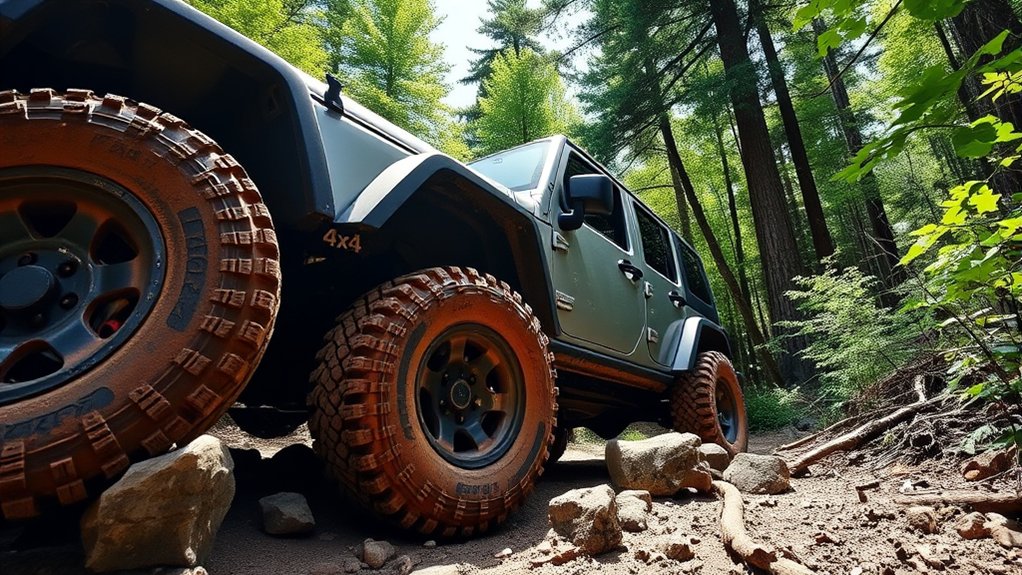
When you see “4×4” on a Jeep, it means that all four wheels can be powered at the same time. This gives you better traction and control, especially on tricky surfaces.
4×4 on a Jeep means all four wheels receive power, enhancing traction and control on challenging terrains.
This drive system is built for off-road adventures, helping you handle mud, snow, or steep hills with confidence. Jeep 4x4s often have full-time four-wheel drive, which automatically sends power where it’s needed without you needing to do anything.
Many models also come with low-range gearing, giving you extra torque for tough obstacles. These advanced systems keep you stable and sure-footed even in rugged environments.
Whether you’re on rough trails or slippery roads, a Jeep with 4×4 is designed to maximize traction and stability on all four wheels.
How Do Jeep 4×4 Systems Improve Traction and Stability?
Jeep 4×4 systems boost traction and stability by actively sending power to all four wheels. This helps you stay in control on slippery or uneven surfaces.
They use mechanisms like transfer cases and locking differentials to get better grip during off-road adventures and bad weather. Traction control systems detect wheel slip and automatically adjust torque to prevent losing traction.
This makes for smoother movement over rough terrain. Electronic stability controls work with four-wheel drive to keep you steady during sharp turns or tough conditions.
These systems also manage torque distribution based on terrain and wheel slip, keeping everything stable. Low-range gearing further improves control in tough off-road situations, making your Jeep more capable and safer in demanding environments.
What Are the Different Types of Jeep 4×4 Systems?
Jeep offers different 4×4 systems tailored to various driving needs, including full-time, part-time, and on-demand setups.
Full-time systems send power to all wheels constantly, providing continuous traction and stability.
Part-time systems require manual engagement for off-road use, giving you control when you need it.
On-demand systems automatically switch between two-wheel and four-wheel drive based on conditions, offering convenience and versatility.
Full-Time Versus Part-Time
What’s the difference between full-time and part-time 4×4 systems? Full-time four-wheel drive constantly sends power to all four wheels and usually has a center differential. This allows smooth driving on dry pavement without risking damage.
In contrast, part-time four-wheel drive needs you to manually switch it on. It’s mainly designed for off-road or low-traction situations. Using part-time 4×4 on dry roads can cause noise, binding, or damage because it’s not built for regular driving.
- Full-time 4×4 provides constant traction and smooth handling on pavement
- Part-time 4×4 gives you manual control for off-road use
- The center differential in full-time systems helps prevent drivetrain stress
- Part-time systems are best used only in low-traction conditions
All-Wheel Drive Differences
Have you ever wondered how different 4×4 systems in Jeep vehicles adapt to various driving conditions? All-wheel drive (AWD) systems automatically distribute power to all four wheels, optimizing traction control and electronic stability without driver input. They’re perfect for on-road use, handling rain, snow, or light off-road scenarios smoothly.
Full-time four-wheel drive, on the other hand, constantly supplies power to all four wheels, often using a center differential or clutch for seamless on-road and off-road performance. Unlike AWD, it’s designed for more serious off-road adventures.
These systems differ in complexity and control, with some offering features like locking differentials or low-range gearing. Understanding these differences can help you choose the right system to match your driving style and conditions.
When and How Should I Use 4×4 Modes on My Jeep?
Knowing when and how to use 4×4 modes is key for safe and effective off-road driving. Engage 4WD when you’re tackling tough terrain like snow, mud, sand, or steep hills to get better traction and control.
Use 4H at low speeds on slippery or loose surfaces. Switch to 4L for steep climbs, descents, or tough obstacles where you need slow, high-torque driving. Always switch to 2WD before hitting paved roads or dry surfaces to avoid damaging the drivetrain, especially with part-time 4WD systems.
Shift into 4WD modes at low speeds—typically below 55 mph for 4H and 25 mph for 4L. Follow your manufacturer’s instructions for engagement. Use low-range 4WD when crawling over rocks or deep snow, then switch back when conditions improve.
How Does Jeep’s Selec-Terrain System Help Off-Roading?
Ever wonder how Jeep’s Selec-Terrain system makes off-roading easier and safer? It offers multiple driving modes like Auto, Snow, Sand, Mud, and Rock, each tailored to different conditions. These modes optimize vehicle performance for each scenario.
Switching modes is simple, usually with a rotary knob, so you can easily adapt to changing terrains. Once engaged, Selec-Terrain automatically adjusts throttle response, transmission shift points, traction control, and suspension settings to maximize grip and stability.
In off-road environments, it can engage low-range gears or activate locking differentials in Rock mode. These features give you better control over obstacles and rough terrain. The system’s real-time adjustments help prevent wheel slip and improve obstacle clearance.
All of this gives you more confidence and control in challenging conditions, making off-roading safer and more enjoyable.
When Should I Engage 4×4 in Real-World Driving Scenarios?
You should engage 4×4 when you’re driving on off-road trails, snow, or mud to get better traction and control. It helps you stay stable and avoid slipping.
Switch to 4×4 low gear at slower speeds when you’re climbing steep hills or dealing with tough obstacles. This gives you more power and control when you need it most.
Always turn off 4×4 on dry pavement to prevent unnecessary wear and potential damage to your vehicle. It’s best to use 4×4 only when the conditions call for it.
Navigating Off-Road Trails
When maneuvering off-road trails, recognizing the right moment to engage 4×4 is key to maintaining control and preventing damage. It’s best to activate 4WD before hitting tricky terrain to get the most traction and keep your Jeep stable.
Use 4×4 in situations like crossing loose gravel, climbing steep hills, or going through muddy, sandy, or snow-covered trails. Shift into 4WD low gear at speeds below 25 mph when crawling over rocks or steep inclines for slow, controlled movement.
It’s a good idea to engage 4×4 proactively rather than waiting until you’re stuck. Doing so helps preserve momentum and control. Remember to disengage 4×4 when you’re back on dry, paved roads to avoid driveline binding and potential damage from locked axles.
Getting the timing right keeps your wheels grounded and ensures your drive stays smooth.
Driving in Snow and Mud
Engaging 4×4 in snow and mud helps you maintain traction and control on slippery surfaces. You should switch to 4WD before hitting deep snow or thick mud to prevent wheel spin and keep your tires gripping.
Engage the rear and front axles at the same time for balanced power distribution. Use a low gear (4WD-LOW) when tackling steep inclines or deep mud, as it provides extra torque and better control at slow speeds.
If your vehicle has a full-time four-wheel drive system, you might not need to switch modes unless conditions get worse. Avoid engaging 4×4 on dry pavement unless your Jeep supports full-time 4WD, to prevent drivetrain damage.
Once you’re out of snow or mud, disengage 4×4 to reduce wear and improve fuel efficiency.
How Do I Properly Engage and Disengage 4×4 on My Jeep?
Properly engaging and disengaging 4×4 on your Jeep helps ensure smooth operation and keeps your drivetrain healthy.
To engage 4WD, shift into neutral, then choose your mode, like 4WD Low or 4WD High. Follow your manufacturer’s speed guidelines—below 55 mph for high range and around 3-5 mph for low range.
Use the transfer case lever or switch to activate 4WD. Always switch modes on low-traction surfaces, like snow or mud, and avoid doing so on dry pavement.
When you’re ready to disengage, shift back to 2WD or the appropriate mode. Make sure the vehicle is at a complete stop or moving slowly for a smooth transition.
Frequently Asked Questions
Is the Jeep 4X4 Always On?
No, your Jeep’s 4×4 isn’t always on. You usually need to manually engage or select 4WD mode, unless it has full-time AWD or automatic systems that turn on automatically when needed.
For models with part-time 4WD, you should only use 4WD on low-traction surfaces to avoid damage. So, you control when 4×4 is active based on driving conditions and your vehicle’s system.
What Is the Difference Between a Jeep 4X4 and 4WD?
The difference between a Jeep 4×4 and 4WD is what they represent.
4×4 refers to the drivetrain setup that powers all four wheels at the same time, giving you better traction on tough terrains.
4WD, on the other hand, describes the system’s modes, like high or low gear, that you can switch depending on the conditions.
Basically, 4×4 is about how the vehicle is built, while 4WD is about how you use that system.
What Is the Average Income of a Jeep Owner?
You might be surprised to learn that the average income of a Jeep owner is quite high, typically between $75,000 and $100,000 annually. This isn’t just about buying a vehicle; it’s about embracing an adventurous lifestyle.
With a stable, middle-aged demographic, these owners often invest in upgrades and accessories. This reflects their disposable income and passion for outdoor pursuits.
Your Jeep is more than a car; it’s a status symbol for those with higher earning power.
What Jeep Models to Stay Away From?
You should avoid older Jeep models with the NP208 transfer case because they lack modern traction control.
Be cautious of early 2000s Cherokees with NV247 or NV249 transfer cases, as they often fail mechanically.
Stay away from Jeep Liberties or Patriots with low ground clearance or weak skid plates.
Also, steer clear of original TJ or early JK Wranglers that don’t have advanced off-road systems.
Poorly maintained or heavily modified Jeeps can also cause reliability issues, so keep an eye out for those.
Conclusion
Understanding what 4×4 means on a Jeep opens up a world of adventure, like a key that unlocks rugged terrains and tough trails. With the right knowledge, you become the captain of your vehicle’s destiny, steering through obstacles with confidence.
Adopting the power of 4×4 lets you confidently take on off-road challenges, turning every journey into an exciting experience. Remember, mastering 4×4 systems transforms each drive into a thrilling story waiting to be told.