How Do You Make Ethanol Fuel in 7 Simple Steps
Are you curious about how ethanol fuel is made, especially if you’re interested in sustainable energy sources? You’re not alone—many people want to understand the process behind producing this eco-friendly fuel and how it can help reduce dependence on traditional gasoline.
To make ethanol fuel in 7 simple steps, start by preparing your raw materials like corn, sugarcane, or fruit waste through chopping and mixing with water.
Next, ferment the sugars by maintaining proper temperature and pH, then distill and purify the liquid by controlling temperature and filtering impurities.
After testing for quality, store the ethanol safely in approved containers.
Finally, blend it with gasoline to produce E85 fuel.
Continue exploring to learn detailed safety tips and precise techniques.
Key Takeaways
- Prepare high-sugar biomass and ferment it with yeast to produce ethanol through controlled fermentation.
- Once fermentation is complete, distill the mixture to separate and purify the ethanol. Aim for a purity above 90%.
- After distillation, filter the ethanol to remove any impurities. Test it to make sure the alcohol content is correct and that it’s free of contaminants.
- Store the purified ethanol in approved, sealed containers. Keep these containers in a cool, well-ventilated area. Be sure to follow all safety and handling precautions.
- You can blend the ethanol with gasoline to create E85 or store it for later use as a biofuel. Always maintain proper storage and handling practices to stay safe.
Legal and Safety Considerations Before Making Ethanol
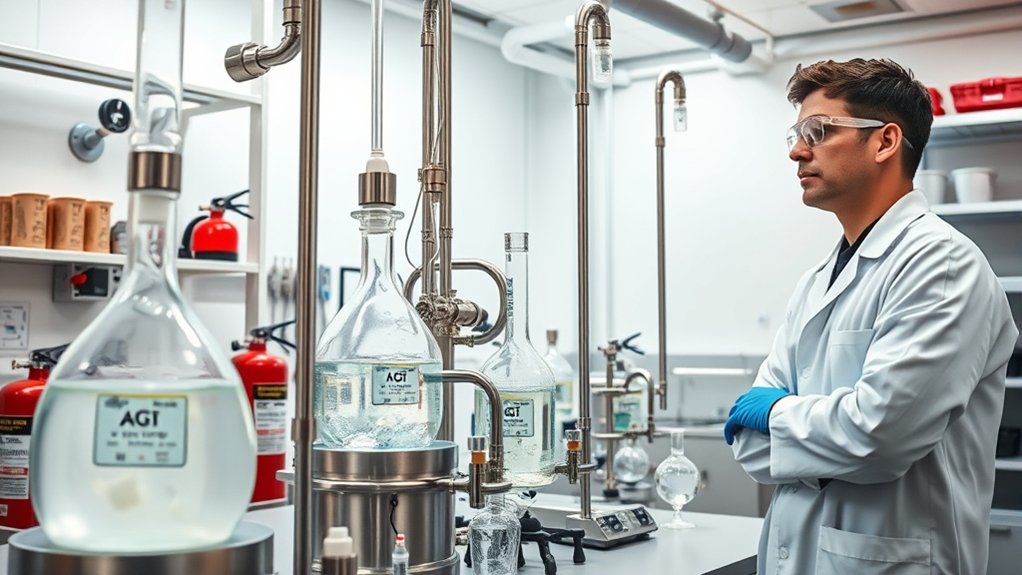
Before you start making ethanol fuel at home, it’s essential to understand the legal requirements and safety precautions involved. Legally, you must obtain permits and approval from the appropriate agency, like submitting an online producer request form to the U.S. TTB.
Producing ethanol without proper licensing can lead to severe legal penalties, including fines and criminal charges. Safety is just as important; work in well-ventilated areas and wear protective gear to prevent fire hazards and exposure to toxic fumes during fermentation and distillation.
Furthermore, handling and storing ethanol must follow regulations on container types, labeling, and storage locations to avoid leaks or accidents. Always adhere to environmental disposal guidelines for waste ethanol to minimize pollution and health risks.
Preparing Raw Materials for Ethanol Production
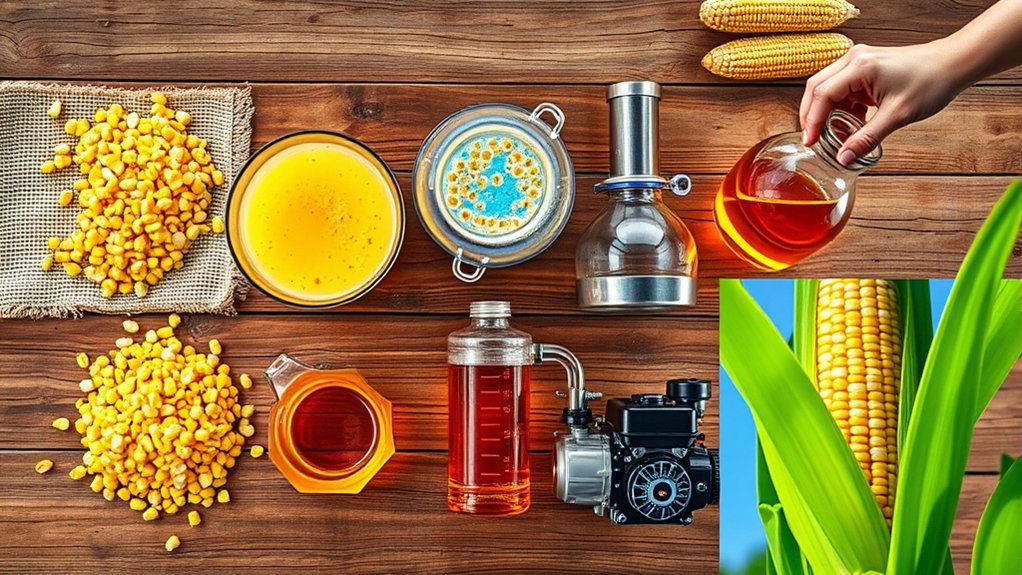
How do you prepare raw materials for ethanol production? First, you need to process raw materials like corn, sugarcane, or fruit waste by chopping or crushing them into a uniform, goopy mixture. This helps release sugars and makes handling easier.
Mix the biomass with water to achieve the right moisture content, which is vital for fermentation. Make sure all equipment and containers are properly sanitized to prevent contamination that could interfere with the process.
High sugar content in your raw materials is essential to maximize ethanol yield, so select and prepare your biomass accordingly. Also, process in a well-ventilated area, especially when dealing with organic waste that can produce unpleasant odors.
Proper preparation sets the stage for successful fermentation and efficient ethanol production.
Fermentation: Converting Sugars Into Ethanol Safely
As you start fermentation, keep the temperature between 75°F and 85°F to ensure the yeast stays active and produces ethanol efficiently. Monitoring the temperature helps keep everything running smoothly.
You also need to check the pH, aiming for around 4.0 to 4.5. This prevents bacteria from spoiling the process and keeps fermentation on track.
Finally, sealing the vessel with an airlock and stirring gently each day helps avoid contamination and encourages even fermentation.
Managing Fermentation Temperature
Maintaining a stable fermentation temperature is key for efficient ethanol production because yeast activity is very sensitive to temperature changes. If the temperature drops below 75°F or rises above 85°F, yeast can slow down or die, leading to incomplete sugar conversion.
To avoid this, regularly check the mixture with a thermometer and adjust heating or cooling as needed. Sudden temperature swings can stress the yeast, causing undesirable byproducts like fusel oils and reducing ethanol yield.
Keeping the temperature within the ideal range ensures active yeast metabolism and results in a cleaner, higher-quality final product. Proper temperature control not only boosts ethanol production but also helps keep fermentation consistent throughout the process.
Ensuring Proper pH Levels
Keeping the fermentation temperature stable is vital, but equally important is ensuring the pH stays within the ideal range. During fermentation, a pH between 4.0 and 4.5 creates good conditions for yeast activity and ethanol production.
Regularly checking pH with test strips or a pH meter helps prevent unwanted bacterial growth and fermentation issues. If pH drops below 4.0, yeast stress reduces alcohol yield; above 4.5, contamination risks go up.
You can adjust pH using food-grade acids like phosphoric acid or bases such as sodium bicarbonate. This helps maintain the proper environment for fermentation to proceed smoothly.
Preventing Contamination Risks
To prevent contamination during fermentation, make cleanliness a top priority and handle your equipment properly. Start by thoroughly sanitizing all fermentation tools with boiling water or chemical sanitizers to kill bacteria, mold, and other contaminants.
Keep the fermentation environment sealed with an airlock to stop oxygen from getting in, which helps prevent unwanted microbes from growing. Use only pure, uncontaminated yeast and water to reduce the chances of introducing bacteria or mold.
Stay strict with cleanliness by avoiding foreign objects or unclean substances in your mixture. Also, monitor and control the fermentation temperature within the recommended 75°F to 85°F range.
Proper temperature control promotes healthy yeast activity and reduces spoilage, helping keep your fermentation process safe and free from contamination.
Distilling and Purifying Ethanol at Home
Setting up your distillation equipment correctly is essential for safe and effective ethanol purification. You’ll need a reflux still to separate ethanol from water and impurities, often requiring multiple runs for higher purity.
Filtering the collected ethanol through activated charcoal or zeolite beads helps remove residual contaminants and boosts fuel quality.
Distillation Equipment Setup
Have you ever wondered how to properly set up distillation equipment to extract ethanol? Your setup should include key components to efficiently separate ethanol from fermented mash.
First, pick a heat source that provides steady, controllable heat. Next, use a distillation flask to hold the fermented mash, making sure it’s sealed properly.
Connect a condenser—either a water jacket or coil—to cool ethanol vapors back into liquid form. Have a collection container ready to gather the purified ethanol.
Proper temperature control is critical. Keep the heat just above ethanol’s boiling point, which is 78.5°C. This setup helps you safely and effectively extract ethanol while minimizing impurities.
It also makes sure your process is efficient and safe.
Purification Techniques
Purification of ethanol at home relies on effective distillation and filtration techniques to remove water and impurities. During distillation, you heat the fermented mash to around 78.5°C (173.3°F), vaporizing ethanol while leaving most water behind.
Using a reflux still improves purity by repeatedly condensing and vaporizing the alcohol, refining its quality. Proper temperature control ensures you selectively vaporize ethanol without co-evaporating water.
Once distilled, filtration further advances purity by removing remaining contaminants. Passing the ethanol through activated charcoal or zeolite beads absorbs residual water and impurities, increasing alcohol concentration.
Repeating the distillation and filtration process multiple times helps you achieve ethanol purity levels above 90%, making it suitable for fuel use. This combination of distillation and filtration is vital for home ethanol purification.
Testing Ethanol Quality and Detecting Impurities
How can you guarantee the ethanol you produce is of high quality and free from impurities? Start by using a hydrometer to measure the alcohol content. Aim for above 90% for top-quality fuel.
Next, carefully smell the sample. Impurities like methanol or fusel oils emit sharp, unpleasant odors. Observe its color and clarity—clear, colorless ethanol indicates fewer impurities.
Furthermore, test for residual water using chemical test kits or check for phase separation. To further improve quality, filter the ethanol through activated charcoal or other purification methods to eliminate remaining contaminants.
These simple, effective steps help ensure your ethanol fuel is pure, safe, and efficient for use.
Storing and Handling Ethanol Fuel Safely
Once you’ve confirmed that your ethanol fuel is pure and safe to use, proper storage and handling are key to keeping it in good shape and safe. Use approved containers made of metal or high-density polyethylene with tight seals to prevent leaks and evaporation.
Store ethanol fuel in a cool, dry, well-ventilated spot away from heat, sunlight, and anything that could ignite it. Clearly label containers as “Ethanol Fuel” to prevent accidental misuse and ensure proper handling.
Regularly check your storage containers for leaks, damage, or rust, and replace them if needed. When handling ethanol fuel, work in well-ventilated areas and wear gloves and goggles to protect yourself from fumes and skin contact.
Proper storage and handling not only keep you safe but also help maintain the fuel’s quality.
Blending Ethanol With Gasoline to Make E85 Fuel
Have you ever wondered how to make E85 fuel? It’s all about blending ethanol with gasoline to get a high-ethanol fuel that works in flexible fuel vehicles. Here’s the process:
First, measure out 85% ethanol and 15% unleaded gasoline.
Use a clean, approved container to prevent any contamination.
Mix thoroughly so the ethanol and gasoline are completely blended, creating a uniform E85 fuel.
Store the mixture in labeled, airtight containers to stop evaporation and keep it clean.
This careful blending makes sure the ethanol and gasoline work together efficiently. Remember, E85 is designed for vehicles that can handle high ethanol content. Once mixed, only use E85 in compatible vehicles or equipment.
Frequently Asked Questions
How Do You Make Ethanol Fuel?
You make ethanol fuel by fermenting sugars from biomass like corn or sugarcane using yeast. First, you crush and extract the sugars.
Then, you add yeast to ferment the mixture. After fermentation, you distill the liquid to separate ethanol from water and impurities, often using a reflux still.
Finally, you dehydrate the ethanol to remove residual water, making sure it’s pure enough to blend with gasoline for fuel use.
How Do You Get Ethanol Fuel?
You get ethanol fuel by blending ethanol with gasoline, usually at an 85/15 ratio to make E85. First, you need ethanol produced through fermentation of biomass like corn or sugarcane.
Then, you carefully mix and store it in approved containers. Remember, “You reap what you sow,” so sourcing quality ethanol is essential for safe, efficient fuel.
Always use ethanol fuel in compatible vehicles or engines designed for it.
How to Make Ethanol for Fuel at Home?
To make ethanol for fuel at home, start by fermenting sugar-rich materials like fruit waste or corn with yeast in a sanitized container.
Keep the temperature steady between 75°F and 85°F for 7-10 days until fermentation completes.
Then, distill the mixture with a still to separate ethanol from water and impurities.
Finally, filter the ethanol and mix it with gasoline to create your own fuel blend.
What Are the 4 Stages of Bioethanol Production?
You might be surprised to learn that bioethanol production involves four key stages. First, you prepare raw materials like corn or sugarcane into a fermentable sugar solution.
Next, yeast ferments these sugars into ethanol and CO₂ over several days. Then, you distill the mixture to separate ethanol from water.
Finally, dehydration produces pure ethanol fuel. These steps transform raw biomass into renewable energy efficiently.
Conclusion
Now that you know the seven simple steps to make ethanol fuel, you’re essentially creating a small-scale oil refinery right in your backyard.
With careful safety measures and patience, you can produce clean-burning ethanol that rivals commercial fuels.
Just remember, mishandling ethanol is like inviting a fiery dragon into your garage—dangerous and destructive.
So, stay cautious, follow the steps precisely, and you’ll be well on your way to fueling your vehicle with homemade ethanol!