How Jet Fuel Is Made Step by Step
Are you curious about how jet fuel is made? Many people wonder what goes into creating the fuel that powers airplanes high above the clouds. It can seem complex and a bit mysterious, but you’re not alone in wanting to understand this process better.
To make jet fuel, crude oil is first extracted from underground or offshore sources and transported to refineries. There, it’s heated in a distillation column to separate hydrocarbons, with jet fuel collected from the middle.
The fuel undergoes hydroprocessing to remove impurities and improve stability. Blending additives ensures it meets safety standards.
Finally, the fuel is tested, stored, and transported via pipelines or trucks.
If you want to uncover all the detailed steps, keep exploring how this process works from start to finish.
Key Takeaways
- Crude oil is pulled from underground reservoirs or offshore sites through drilling. Then, it gets transported to refineries for processing.
- At the refinery, the crude oil goes through distillation. This process separates jet fuel from other hydrocarbons based on their boiling points.
- Next, hydroprocessing happens. Hydrogen and catalysts are used to remove impurities like sulfur, which helps improve the fuel’s stability and quality.
- After that, the jet fuel is blended with various hydrocarbons and additives. This step makes sure the fuel meets all industry standards for performance and safety.
- Finally, the refined jet fuel is transported via pipelines, trucks, or ships. It’s then stored and delivered to airports for fueling aircraft.
How Is Crude Oil Extracted and Prepared for Refining?
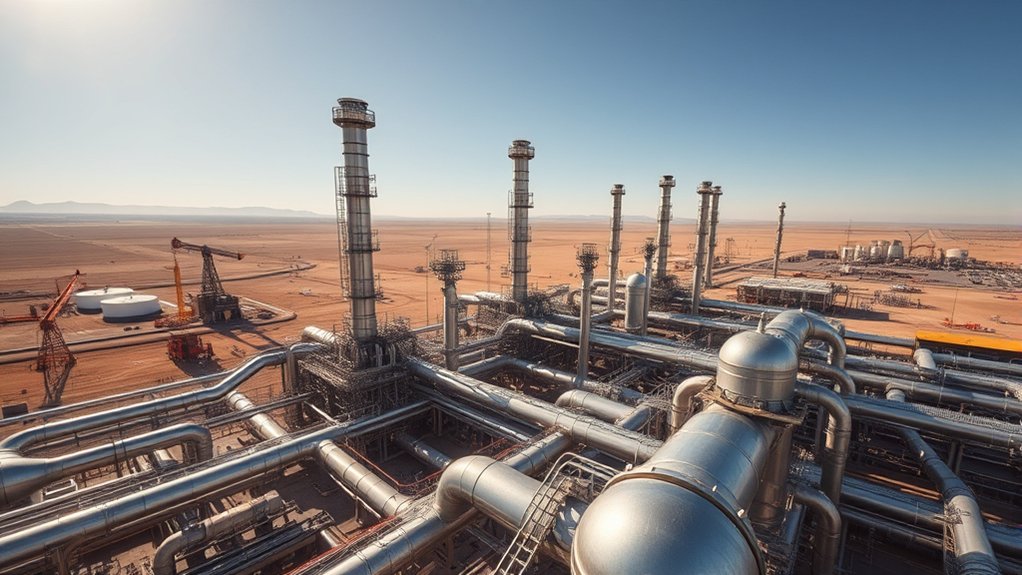
Crude oil is found through geological surveys and exploratory drilling in underground reservoirs or offshore sites. Once located, drilling wells are built to extract the crude oil from deep beneath the Earth’s surface or seabed.
After extraction, the oil is transported via pipelines, ships, or rail to refineries for processing. Before refining begins, the crude oil undergoes preliminary testing and sampling to analyze its composition and quality.
During initial storage and handling, impurities like water, sediments, and dissolved gases are removed to guarantee cleaner processing. This preparation step is vital because the crude oil’s composition varies, affecting the refining process.
Removing impurities improves the quality of the final products, including jet fuel, and ensures safe, efficient refining. Proper extraction and initial handling set the foundation for producing high-grade fuel.
How Does Distillation Separate Hydrocarbon Fractions for Jet Fuel?
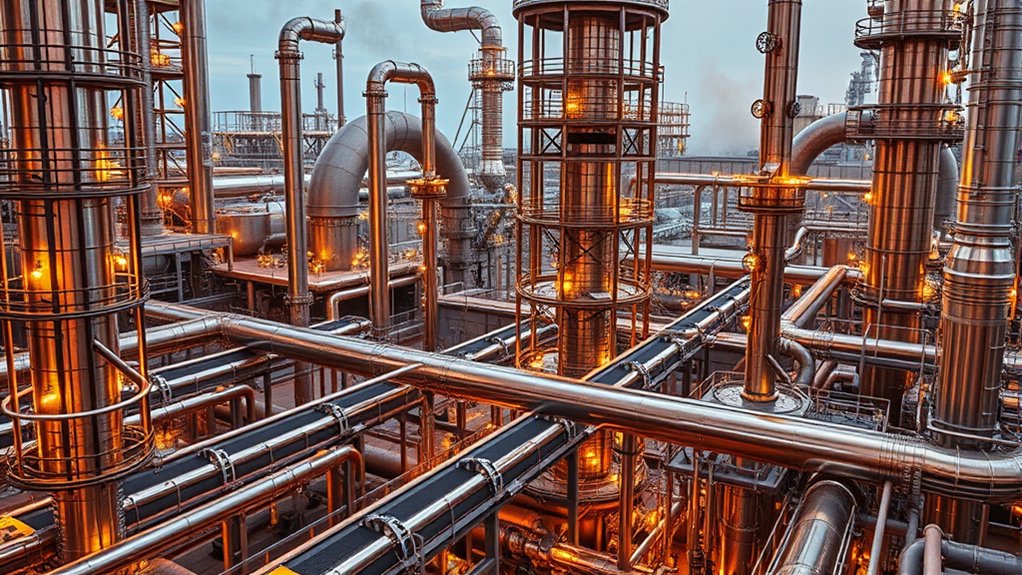
Distillation is a key process that separates different hydrocarbon parts in crude oil based on their boiling points. You heat the crude oil in a fractionating column, causing hydrocarbons to vaporize at specific temperatures.
Lighter hydrocarbons, like gases and naphtha, rise to the top, while heavier ones such as kerosene and diesel settle lower in the column. The jet fuel fraction is usually collected from the middle, where it condenses within a boiling range of 200-305°C.
Precise temperature control and tray design inside the column make this separation effective, even when hydrocarbons have overlapping boiling points. This process ensures each hydrocarbon fraction is isolated for further refining into jet fuel.
What Happens During Hydroprocessing to Improve Jet Fuel Quality?
Hydroprocessing is a key step in refining jet fuel, where hydrogen works with catalysts to remove impurities and improve quality. During this process, sulfur, nitrogen, and oxygen compounds are eliminated through catalytic treatment, resulting in cleaner fuel.
Hydroprocessing uses hydrogen and catalysts to remove impurities, ensuring cleaner, higher-quality jet fuel.
Hydrocarbon molecules undergo saturation, turning unsaturated compounds like alkenes and aromatics into more stable, saturated forms such as cycloalkanes. This boosts fuel stability and helps prevent gum formation and deposits during storage and combustion.
Key steps include sulfur removal, which reduces sulfur content to meet environmental standards. Saturation of hydrocarbons improves fuel stability, and impurities are significantly lowered to enhance purity.
Catalytic treatment ensures the final jet fuel is safer, of higher quality, and compliant with strict regulations.
How Are Hydrocarbons and Additives Blended to Meet Standards?
To guarantee jet fuel performs reliably and meets strict safety standards, refiners carefully blend hydrocarbons like kerosene, naphtha, and other fractions in precise ratios. This blending process makes sure the fuel’s properties, such as density, freezing point, and energy content, match industry specifications.
Additives like antioxidants, anti-icing agents, static dissipators, and corrosion inhibitors are mixed into the base hydrocarbons to boost performance and safety. Through careful measurement and mixing, the final product is made to meet the standards set by organizations like ASTM International.
Quality control is essential, verifying that each batch meets all necessary specifications, including flash point, freeze point, and stability. Only then is the fuel ready to leave the refinery for distribution.
How Is Jet Fuel Tested to Ensure Safety and Performance?
You need to guarantee jet fuel meets strict safety and performance standards before it’s used. Testing focuses on factors like flash point, freeze point, and energy density to verify it’s safe and efficient.
These quality control checks help prevent hazards and ensure reliable operation in various conditions.
Quality Control Tests
How exactly is jet fuel tested to guarantee it meets safety and performance standards? You rely on rigorous quality control tests to verify essential properties.
These include measuring the flash point with the Cleveland Open Cup test to make sure it’s above safety standards. Checking the freeze point ensures fuel stays fluid at extremely low temperatures, like -47°C.
Gas chromatography is used to analyze the hydrocarbon composition and spot impurities such as sulfur, metals, or heteroatoms. Static electricity tests are also performed to prevent dangerous static buildup during storage and handling.
All these tests help identify impurities, confirm fuel stability, and meet strict safety standards, ensuring jet fuel performs reliably during flight and storage.
Safety and Performance Standards
Ensuring jet fuel meets strict safety and performance standards involves a series of precise tests that verify its key properties. You check the flash point to make sure it’s safe to handle and store, while the sulfur content must stay below 0.3% to prevent engine corrosion and reduce emissions.
Stability tests confirm the fuel won’t gum or degrade under extreme conditions, supporting reliable engine operation. Impurities are detected through spectrometry and chromatographic analysis to ensure the fuel’s chemical composition is correct.
Final quality assurance includes fire point testing and visual inspections, confirming compliance with international safety standards. These rigorous measures guarantee that the jet fuel you rely on performs safely and efficiently, meeting the highest industry standards for safety and quality assurance.
What’s New in Sustainable Jet Fuels and Industry Innovations?
Recent breakthroughs in sustainable jet fuels are transforming the industry by introducing innovative production methods and expanding the use of renewable resources.
Industry innovations like Fischer–Tropsch synthesis, HEFA, and alcohol-to-jet processes enable the production of renewable aviation fuel from algae, waste oils, and biomass. These advancements lead to bio-based kerosene that can be blended up to 50%, reducing carbon emissions and moving toward carbon-neutral aviation.
Recent initiatives include commercial flights using 100% synthetic fuels and exploring seawater electrolysis to produce jet fuel directly from renewable electricity. To support this progress, governments and industry leaders are developing fuel certification standards and scaling production capacities.
This ensures sustainable jet fuels meet safety and performance requirements while pushing toward a net-zero emissions future. Adoption of cutting-edge processes like Fischer–Tropsch synthesis, development of bio-based kerosene from diverse biomass sources, and flight demonstrations on 100% synthetic fuels are all part of this push.
Investment in renewable electricity to produce jet fuel directly is also growing. These efforts are helping the industry move closer to a sustainable, low-carbon future for aviation.
How Is Jet Fuel Stored, Transported, and Distributed to Airports?
Jet fuel flows through a carefully coordinated network of storage and transportation systems to reach airports safely and efficiently. Large storage tanks at refineries, airports, and distribution centers hold the fuel, connected by pipelines for long-distance transport.
Pipelines are the main way jet fuel is moved, equipped with leak detection and safety systems to prevent accidents. Tanker trucks, railcars, and ships designed for flammable liquids also play roles in transportation, offering flexible delivery options.
At airports, fuel is transferred into storage tanks using specialized loading arms and metering systems that control flow and maintain quality. From there, jet fuel is distributed to aircraft through underground fueling systems or mobile refuelers.
All of these processes follow strict safety standards and temperature controls to ensure safe fueling operations.
Frequently Asked Questions
Could Europe Run Out of Jet Fuel?
Yes, Europe could run out of jet fuel if supply disruptions occur or refinery capacities can’t keep up with demand. Relying heavily on imports makes the region vulnerable to geopolitical tensions and global supply issues.
While shifting to sustainable aviation fuels helps cut dependence, it will take time to see significant impact. In the meantime, keeping strategic stockpiles and diversifying sources are your best bets.
These steps can help ensure flights keep flying even during crises. Being prepared now is key to avoiding potential shortages down the line.
What Is the Process of Making Jet Fuel?
You start by heating crude oil in a refinery, which separates it into different hydrocarbon fractions including kerosene.
This kerosene then undergoes hydroprocessing to remove impurities and improve its quality. After that, it’s blended with additives and possibly renewable fuels to meet aviation standards.
Once all the blending is done, the jet fuel goes through thorough testing to ensure safety and performance. Finally, it gets distributed for use in aircraft engines worldwide.
Which Country Is Running Out of Jet Fuel?
You should know that some island nations and landlocked regions are running out of jet fuel because of supply disruptions.
Countries that rely heavily on imports or have limited refining capacity are especially vulnerable during global crises.
Places like Venezuela and Nigeria are also facing shortages due to refinery outages.
Political conflicts and sanctions make exports even more difficult, which worsens the problem.
This makes it hard for these regions to keep air travel running smoothly.
How Many Weeks of Jet Fuel Does Europe Have Left?
You have about 2 to 4 weeks of jet fuel left in Europe, depending on how much airlines fly and fuel consumption rates. If flight activity stays high or increases, your reserves could run out sooner.
Europe’s reliance on imported oil makes its supply vulnerable to disruptions. To avoid shortages, authorities are considering stockpiling and finding alternative fuel sources.
Conclusion
Now that you’ve seen how jet fuel is crafted step by step, it’s clear that producing this essential energy source is a complex dance of science and precision. Like a finely tuned engine, each process ensures safety, quality, and sustainability.
As innovations take flight, you can be confident that future fuels will soar even higher in efficiency and eco-friendliness. The journey from crude oil to the skies is truly an intricate symphony of industry expertise.
And at the heart of it all is jet fuel—making sure every flight is powered safely and efficiently.