

Who Invented Spark Plugs and What Is Their History?
Are you tired of your car’s engine misfiring or struggling to start? You’re not alone—many drivers face these issues, often without knowing the simple part that could fix them: spark plugs. Understanding their history can help you appreciate how far they’ve come and why choosing the right ones matters.
You might be surprised to learn that the development of spark plugs involved many inventors, with key contributions from Gottlob Honold, who patented an early design in 1902, and Sir Oliver Lodge, who improved electric ignition systems in the early 1900s.
Jean Lenoir also played a role with his internal combustion engine in 1858. If you want to investigate how these innovations shaped modern spark plugs, there’s more to uncover just ahead.
Key Takeaways
- Edmond Berger developed an early spark plug design back in 1839. However, it didn’t get patent protection, nor was it used practically at the time.
- It wasn’t until 1902 that Gottlob Honold patented the first well-documented spark plug. His work really pushed forward modern ignition technology.
- Around the same period, Sir Oliver Lodge played a role in electric spark ignition systems. His contributions influenced how spark plugs were developed.
- Major companies like Bosch, Champion, and NGK built on these early innovations. They focused on improving materials and designs to make spark plugs more reliable and efficient.
- Looking ahead, the future of spark plugs includes smart, durable, and plasma-based ignition systems. These advancements aim to boost engine performance and efficiency.
Who Invented the First Spark Plug?
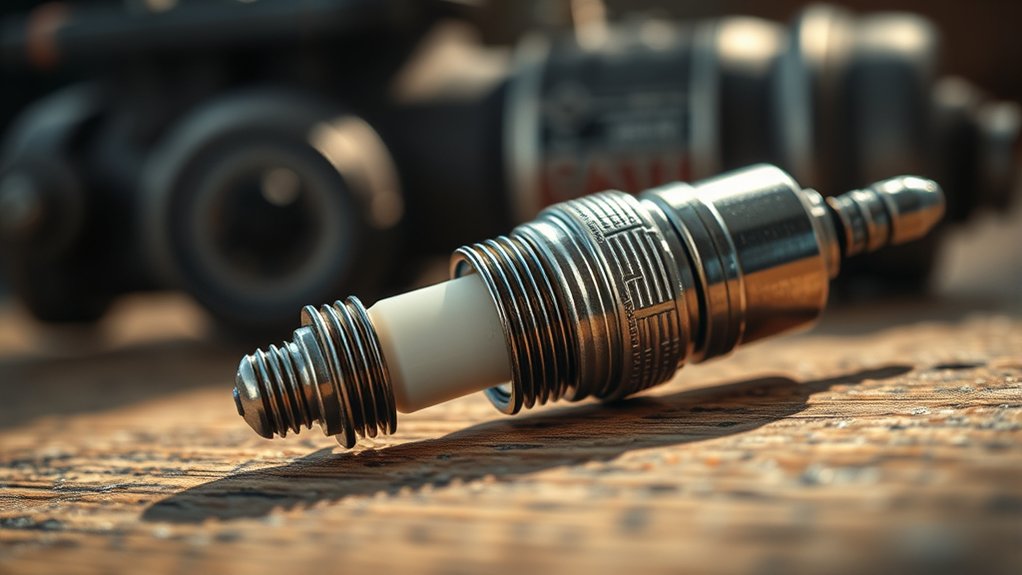
The invention of the first spark plug dates back to 1839, when Edmond Berger is believed to have developed an early design. As you look into the history of the spark plug, you’ll see that Berger’s creation used electricity to generate a spark between electrodes, igniting fuel inside engines.
However, his design didn’t get a patent, and there’s little evidence it was used commercially. Most of the credit for practical ignition systems goes to Sir Oliver Lodge in the early 1900s.
Still, Berger’s work marks the start of the spark plug’s evolution. The first spark plug, in the traditional sense, was later patented by Gottlob Honold in 1902, building on earlier experiments.
Berger’s contribution remains a key milestone in this technological journey.
Early Ignition Systems and Their Inventors
Before spark plugs became standard, early ignition systems relied on simple methods like friction or heat to produce sparks and ignite fuel. These primitive systems included devices that used static electricity or heated elements, offering limited reliability.
Edmond Berger is believed to have invented an early form of the spark plug in 1839, though he never patented his design. Sir Oliver Lodge advanced ignition technology by developing the electric spark ignition system in the early 1900s and co-founded the Lodge Plug Company.
Edmond Berger’s 1839 spark plug innovation laid the foundation for modern ignition systems.
His work greatly improved ignition efficiency. Meanwhile, other inventors like Nikola Tesla and Frederick Richard Simms also contributed to the evolution of ignition systems.
These early innovations laid the groundwork for the modern spark plugs used in today’s engines.
Edmond Berger’s Claim: Did He Create the First Spark Plug?
Many believe Edmond Berger experimented with early spark plug designs in 1839, but there’s little concrete proof. His patents and usage records are scarce, and most experts see his claims as unverified.
Most importantly, the first recognized, patented spark plug was created by Gottlob Honold in 1902.
Berger’s Experimental Designs
Edmond Berger’s claim to have invented an early spark plug in 1839 has intrigued historians, but there’s little concrete evidence to support it. His experimental designs likely aimed to explore different ways to generate sparks, but these early attempts didn’t lead to practical devices.
Berger’s work seems to have been more about experimenting than creating functional tools. His efforts focused on testing ideas rather than developing widespread, usable technology.
Without patents or industrial use, his contributions appear limited to theoretical or trial phases. They didn’t translate into real-world applications or influence later developments.
Most experts credit inventors like Sir Oliver Lodge with creating practical electric spark ignition systems. Berger’s involvement in spark plug development remains speculative.
His designs didn’t shape the evolution of spark plug technology. Overall, his experimental efforts are seen more as curiosity than as milestones in the field.
Patent and Usage Records
Despite Berger’s early experiments with spark generation, there’s little to support his claim of inventing the first spark plug through official records. Patent records are key in establishing the history of inventions, but Berger’s disputed invention lacks such documentation.
His design isn’t covered by any patents, and there’s no detailed usage record to verify his role in the early development of spark plugs. This absence of formal documentation makes his contribution largely speculative.
The earliest well-documented and commercially successful spark plug was created by Gottlob Honold in 1902, with clear patent records supporting his work. Without official patents or usage records, Berger’s claim remains unsubstantiated, and his role in the invention’s history continues to be debated.
Historical Evidence and Claims
While Edmond Berger is often credited with inventing an early form of the spark plug in 1839, there’s no solid evidence to back up this claim. The historical evidence supporting Berger’s role is weak; no patent records or detailed documentation exist to confirm his invention.
Early inventors like Sir Oliver Lodge and Gottlob Honold are widely recognized for significant advances in spark plug technology in the early 1900s, backed by patents and documented development. Berger’s supposed invention predates these by decades, which raises doubts about its authenticity.
The absence of concrete proof or acknowledgment from established automotive history sources suggests his claim remains unverified and speculative. Without solid historical evidence, it’s unlikely that Berger created the first functional spark plug used in engines.
Jean Lenoir and the Development of Internal Combustion Engines
Jean Lenoir played a pivotal role in the evolution of internal combustion engines by developing the first successful model that used a spark ignition system in 1858. His engine, patented as US #345596, was among the earliest practical internal combustion engines fueled by coal gas and air.
Jean Lenoir’s 1858 spark ignition engine revolutionized internal combustion technology and laid the foundation for modern automotive development.
This innovation showed how electrical sparks could be used for ignition and influenced future ignition system designs. His work laid the groundwork for spark plug development, which is essential for reliably igniting fuel in internal combustion engines.
Lenoir’s advancements had a big impact on the growth of automotive and industrial applications. His contributions helped pave the way for the modern engines we use today.
- Pioneered early internal combustion engine technology
- Introduced practical spark ignition for fuel ignition
- Influenced future ignition system innovations
- Enabled advancements in automotive engineering
- Laid foundation for spark plug development
Oliver Lodge and the Invention of the Electric Spark Igniter
Oliver Lodge transformed engine ignition technology in the early 1900s by inventing the electric spark igniter, commonly known as the Lodge Igniter. This innovation greatly improved the reliability of spark ignition systems in internal combustion engines.
As an inventor and scientist, Oliver Lodge’s work in radio and wireless transmission helped advance electrical ignition technology, making it more efficient. Recognizing its importance, he co-founded the Lodge Plug Company in 1903 to manufacture and promote his spark plug invention.
The electric spark igniter played a vital role in the evolution of modern spark plugs used in automobiles and other engines. Lodge’s pioneering work laid the foundation for the development of dependable ignition systems, shaping the future of automotive and engine technology.
Albert Champion and the Commercial Rise of Spark Plugs
Albert Champion’s innovative approach to manufacturing sparked a commercial upheaval in spark plug technology. By founding the Champion Ignition Company in 1904, he established a leading name in spark plug production.
His company supplied spark plugs for early aviation and trans-Atlantic flights, which helped speed up their adoption and technological progress. In 1908, Champion launched the AC Spark Plug Company with Buick’s support, expanding spark plugs into mainstream cars.
His innovations made spark plugs more reliable and better performing. This helped transform them from experimental devices into essential parts of vehicles. His work also influenced aviation and space exploration.
Albert Champion’s legacy in automotive history is lasting. His contributions helped make spark plugs a crucial component and pushed forward transportation technology.
How Spark Plug Designs Evolved Over the 20th Century
Throughout the 20th century, spark plug designs saw major improvements aimed at boosting ignition efficiency, lifespan, and performance. Early designs used simple metal electrodes, but later innovations created more complex, multi-electrode systems for better durability and consistent sparks.
Spark plug innovations in the 20th century enhanced durability, efficiency, and engine performance through advanced electrode designs.
The 1930s introduced resistor spark plugs, which reduced electromagnetic interference and helped electronic devices work better. Material advances like nickel alloys and platinum increased heat resistance and made spark plugs last longer.
Mid-century, surface-discharge and multiple ground electrode designs came into play, extending spark plug life and making ignition more reliable. Toward the late 20th century, innovations like the E3 DiamondFire with multiple sharp edges improved combustion and cut emissions.
These advancements transformed spark plug design and had a direct impact on how efficient internal combustion engines became.
Key Inventors and Companies Shaping Spark Plug Innovation
Several key inventors and companies have driven the evolution of spark plug technology, shaping how engines ignite fuel efficiently. Robert Bosch’s development of the first successful commercial spark plug in 1902 transformed automotive ignition systems.
Albert Champion founded Champion Ignition Company in 1904 and later AC Spark Plug Company in 1908, providing vital components for racing and aerospace. Sir Oliver Lodge’s invention of the electric spark ignition system and co-founding of Lodge Plug Company greatly contributed to early spark plug design.
While Edmond Berger is sometimes credited with an early spark plug in 1839, his lack of a patent limits his influence. Other innovators like Nikola Tesla and Gottlob Honold also advanced spark plug technology during the late 19th and early 20th centuries.
Advances in Materials and Manufacturing for Better Spark Plugs
Innovations in materials and manufacturing techniques have driven the evolution of spark plugs, making them more durable and reliable than ever. Using sintered alumina ceramic, engineers have improved heat resistance and electrical insulation, helping spark plugs work efficiently under extreme conditions.
High-dielectric-strength insulators now handle voltages up to 60kV without breaking down, boosting performance and safety. Manufacturing methods like cold rolling of metal shells strengthen threads and prevent thermal fatigue during installation.
The use of noble metal electrodes, such as platinum and iridium, significantly extends spark plug lifespan and resists electrode erosion. Advanced sealing techniques, including compressed glass and metal powder seals, improve durability and prevent leaks into the combustion chamber.
These advancements keep pushing spark plug technology forward, ensuring better performance and longer-lasting operation.
How Spark Plug Technology Has Improved Durability and Performance
Advancements in spark plug technology have significantly improved durability and performance, helping these parts withstand harsh engine conditions and run more efficiently. Modern electrode designs, like multiple ground electrodes and fine-wire centers, boost spark stability and ignition efficiency.
Using platinum spark plugs and iridium greatly extends their lifespan, often beyond 100,000 miles. Better insulator materials, such as glazed alumina ceramics, increase thermal resistance and prevent electrical tracking under high-pressure conditions.
Improved sealing techniques, including internal metal seals and crush washers, help prevent combustion chamber leaks and make spark plugs last longer. Plus, surface-discharge and multi-electrode designs optimize spark performance across different ignition systems, enhancing engine longevity and reliability.
Who Holds Patent Rights and What’s Next for Spark Plug Technology?
Today, companies like Bosch, NGK, and Denso hold key patents shaping spark plug innovation.
Recent trends focus on advanced materials and environmental improvements, guiding future designs.
As technology evolves, expect spark plugs to integrate more with electronic systems and become even more durable.
Key Patent Holders
Since the early 1900s, various companies and inventors have held key patents shaping spark plug technology. Gottlob Honold secured the first successful patent in 1902 for a functional design, marking a major milestone in spark plug development.
Today, patent rights are held by numerous automotive and electronics companies, pushing innovations forward. You’ll find ongoing advancements in electrode materials like platinum and iridium, along with multi-electrode designs.
Albert Champion’s patents and the founding of Champion Ignition Company contributed to early spark plug evolution. The patent landscape continues to evolve with new materials and configurations.
Understanding these key patent holders helps you see how spark plug technology has progressed and what innovations may shape the future.
- Gottlob Honold’s 1902 patent set the foundation
- Champion Ignition Company spearheaded early innovations
- Patent rights now belong to global automotive giants
- Focus on electrode materials like platinum and iridium
- Ongoing patent filings drive future spark plug tech
Recent Innovation Trends
Recent innovation trends in spark plugs are quite exciting. Companies like E3 Spark Plugs, NGK, Bosch, and Denso are leading the way, holding patents for advanced materials and electrode designs.
Lately, the focus has been on iridium electrodes to extend lifespan and improve fuel efficiency. Many patent rights for these innovations are held by specialized manufacturers.
Emerging innovations include surface-discharge designs that boost ignition reliability and multi-electrode setups for better performance. Automakers are also exploring smart sensors embedded in spark plugs.
These sensors enable real-time performance monitoring and diagnostics. Combined with new electrode materials, they aim to make ignition systems more durable and environmentally friendly.
Patent activity is accelerating as the industry pushes for smarter, more efficient ignition solutions that meet the demands of modern vehicles.
Future Development Directions
As the industry advances with innovations like smart sensors and plasma ignition, the landscape of patent ownership is becoming more important for shaping future developments. Major companies like NGK, Denso, and Bosch hold key patents for modern spark plug designs, including multi-electrode and iridium models.
Future efforts are focusing on creating smarter, self-adjusting spark plugs that incorporate sensors for real-time engine optimization. Researchers are also exploring wireless ignition systems and plasma-based ignition technologies to replace traditional spark gaps.
Patent disputes and licensing agreements will play a big role in how these innovations are commercialized and adopted. Staying aware of patent rights will be crucial as these technologies continue to evolve.
Key areas include developing smart spark plugs with real-time engine data, advances in plasma-based ignition for higher efficiency, and wireless ignition systems replacing traditional spark gaps.
Patents will influence commercialization strategies, and ongoing innovations aim to improve durability and performance in future spark plug designs.
Frequently Asked Questions
Who Really Invented the Spark Plug?
You might think Edmond Berger invented the spark plug, but the real inventor is Gottlob Honold. He developed the first successful, patented spark plug for automotive use in 1902.
While others like Sir Oliver Lodge contributed to its development, Honold’s design became the foundation for modern spark plugs. Many engineers improved upon his work, but Honold’s invention is recognized as the key breakthrough in spark plug technology.
What Kills Spark Plugs Quickly?
Like a silent assassin, improper maintenance guarantees spark plugs fail quickly. Using incorrect gaps, poor-quality fuel, or neglecting regular inspections leads to deposits, fouling, and electrode erosion.
Running your engine at high speeds or heavy loads creates heat that speeds up wear. Oil leaks and excessive oil consumption cause fouling and shorten the lifespan of spark plugs.
To keep your spark plugs alive longer, make sure to set the proper gaps, use good fuel, and check them regularly for wear or deposits.
What Spark Plugs for 06 Sienna?
For your 2006 Sienna, you should use platinum or double platinum spark plugs, like Denso or NGK. Make sure they match the recommended sizes of 3/4 inch or 13/16 inch diameter.
Check that the spark plug gap is between 0.044 and 0.052 inches for the best performance. Regularly replace your spark plugs every 60,000 to 100,000 miles.
This will help keep your engine running smoothly and efficiently.
What Spark Plugs Are Best for Lexus?
Are you wondering which spark plugs give your Lexus the best performance?
You should go with platinum or iridium designs because they last longer and resist wear better.
Lexus recommends OEM brands like Denso or NGK for a perfect fit and reliable function.
Do you know the correct heat range for your model? Regularly replacing high-quality plugs ensures smooth running, better fuel efficiency, and lower emissions.
Conclusion
Now that you’ve explored the intriguing history of spark plugs, you can see how many inventors and innovations have shaped this vital component.
From early ignition systems to modern materials, each breakthrough boosts your engine’s performance. Think about it—without these advancements, would your car run smoothly?
Spark plugs might be small, but their evolution shows that even tiny inventions can power the biggest journeys. Isn’t it amazing how history drives progress?